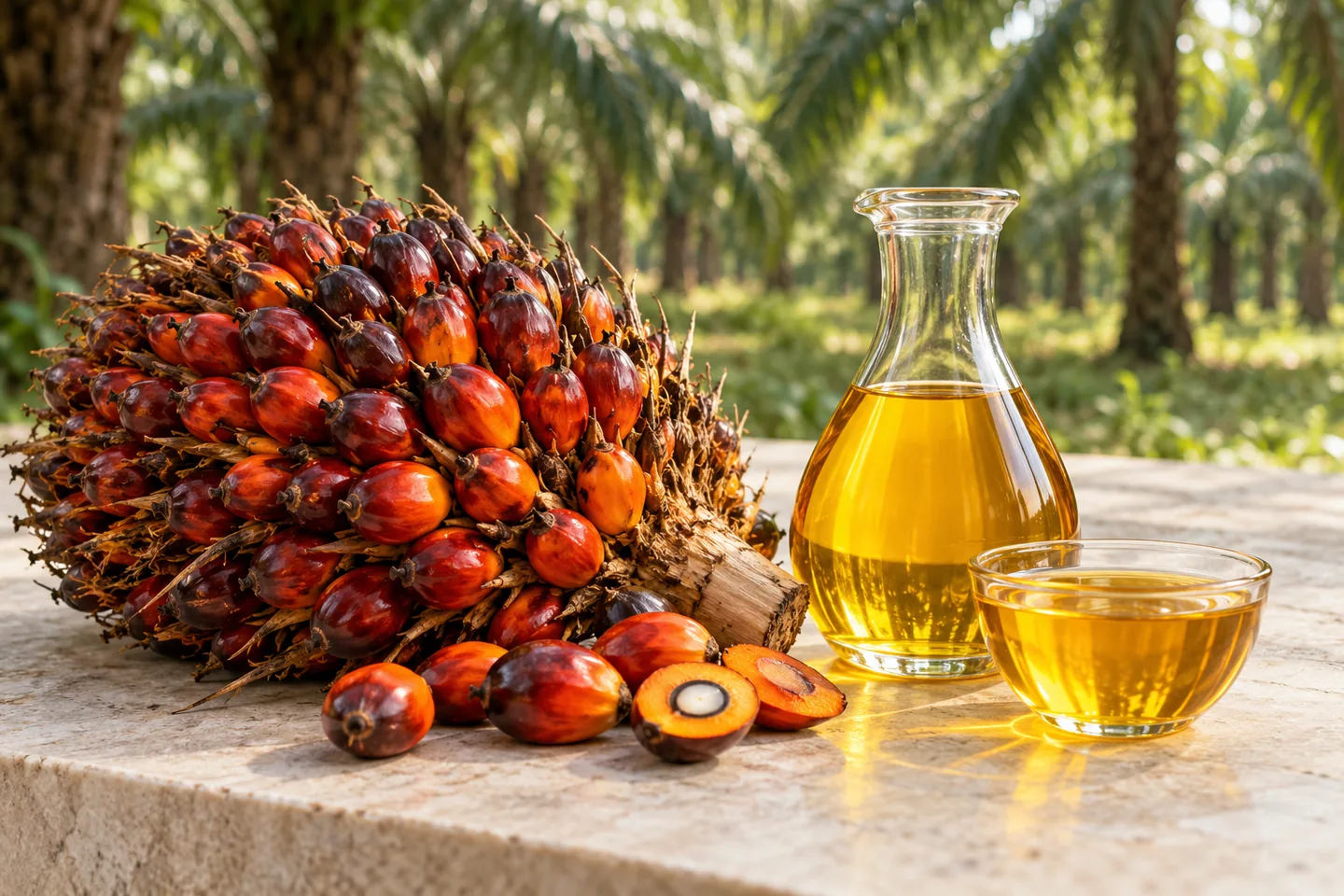
Crude and refined palm oils, refined fractions and oleochemical inputs for food processors and industrial manufacturers. We start with the application: a frying oil, a bakery fat and a detergent feedstock require different purchasing specifications.
Cooking and industrial frying · Bakery fats, margarine and food formulations · Soaps, detergents and personal care · Rubber processing, candles and industrial chemistry
Crude palm oil
CPO is a feedstock for refining and downstream processing. Enquiries should identify the intended refinery use, free fatty acid limits, moisture and impurities, quantity and delivery basis. Crude palm kernel oil is a distinct lauric oil; specify it separately.
Refined palm oil and fractions
RBD palm oil is refined, bleached and deodorised. Further fractionation produces liquid palm olein, commonly used for cooking and frying, and the harder palm stearin fraction used in shortening, margarine and industrial processing. Palm mid fractions serve more specialised fat formulations.
Fatty acids
Distilled and fractionated fatty acids serve soap, candle, rubber, lubricant and chemical manufacturing. State the required fatty acid or carbon-chain distribution rather than requesting a generic palm derivative. Acid value, iodine value, colour and physical form help distinguish suitable grades.
Fatty alcohols
Fatty alcohols are inputs for surfactants and personal-care formulations. Chain length, composition and the required purity determine suitability. A manufacturer’s technical data sheet should be matched to the buyer’s formulation before an alternative grade is accepted.
Refined glycerine
Glycerine functions as a humectant, solvent and formulation ingredient. Industrial, food and pharmaceutical requirements differ. Specify purity, intended use and the required compendial or food specification; the word “refined” alone does not establish suitability.
Fatty acid methyl esters
Methyl esters are used in biofuel and industrial applications. State whether the requirement is a fuel blendstock or a chemical input. Fuel specifications and cold-flow requirements must be agreed for the destination and use.
Technical overview
Fractions and derivatives are different routes.
Oil fractions
Crude palm oil
Refining to RBD palm oil
Fractionation into olein and stearin
Oleochemical conversion
Palm and palm kernel oil feedstocks
Product-specific chemical processing
Fatty acids, alcohols, glycerine and methyl esters
Simplified classifications, not a plant process design. Fractions are separated physically; derivatives require product-specific chemical processing.
Specification guide
Select by use, then by analysis
General purchasing guidance. Grade examples and reference standards are subject to technical review; availability and final acceptance criteria are agreed for each order.
Product family
Technical distinction
Include in the specification
Crude palm oil / palm kernel oil
Different feedstocks; kernel oil is a lauric oil
Identity, free fatty acids, moisture, impurities and intended refining use
RBD palm oil
Refined, bleached and deodorised oil
Colour, FFA, moisture and application requirements
Palm olein / palm stearin
Liquid / harder fractions obtained by fractionation
Iodine value, cloud or melting behaviour and test method
Fatty acids / fatty alcohols
Chemical inputs selected by chain distribution
Composition, acid or hydroxyl value as applicable, colour and physical form
Glycerine / methyl esters
Different chemistry and end-use requirements
Purity and use-specific specification; fuel properties where applicable
Procurement notes
One feedstock, different buying decisions
Palm olein and palm stearin are separated fractions; fatty acids, fatty alcohols, glycerine and methyl esters are chemically different product families. We structure the enquiry around the material your process actually requires.
Define the performance requirement
For olein, identify the required cloud point and test method, not only a trade name such as CP8 or CP10. For harder fractions, agree melting behaviour and iodine value. Final limits belong in the agreed specification.
Separate product grade from certification
Food-use documentation, traceability and any sustainability chain-of-custody requirement should be requested explicitly. Certificates must apply to the actual producer, product and shipment; no certification is assumed from the product name.
Packing, inspection & documentation
Discuss bulk tanker, suitable tank container, drum, IBC or bagged solid formats according to the product. Agree heating and unloading arrangements, cleanliness requirements, seals, batch identification and the certificate of analysis before shipment.
Palm Oil and Derivatives · Enquiries
A useful quotation starts here.
Send the details below. Supply scope, specification, origin and commercial terms are confirmed in the individual offer.