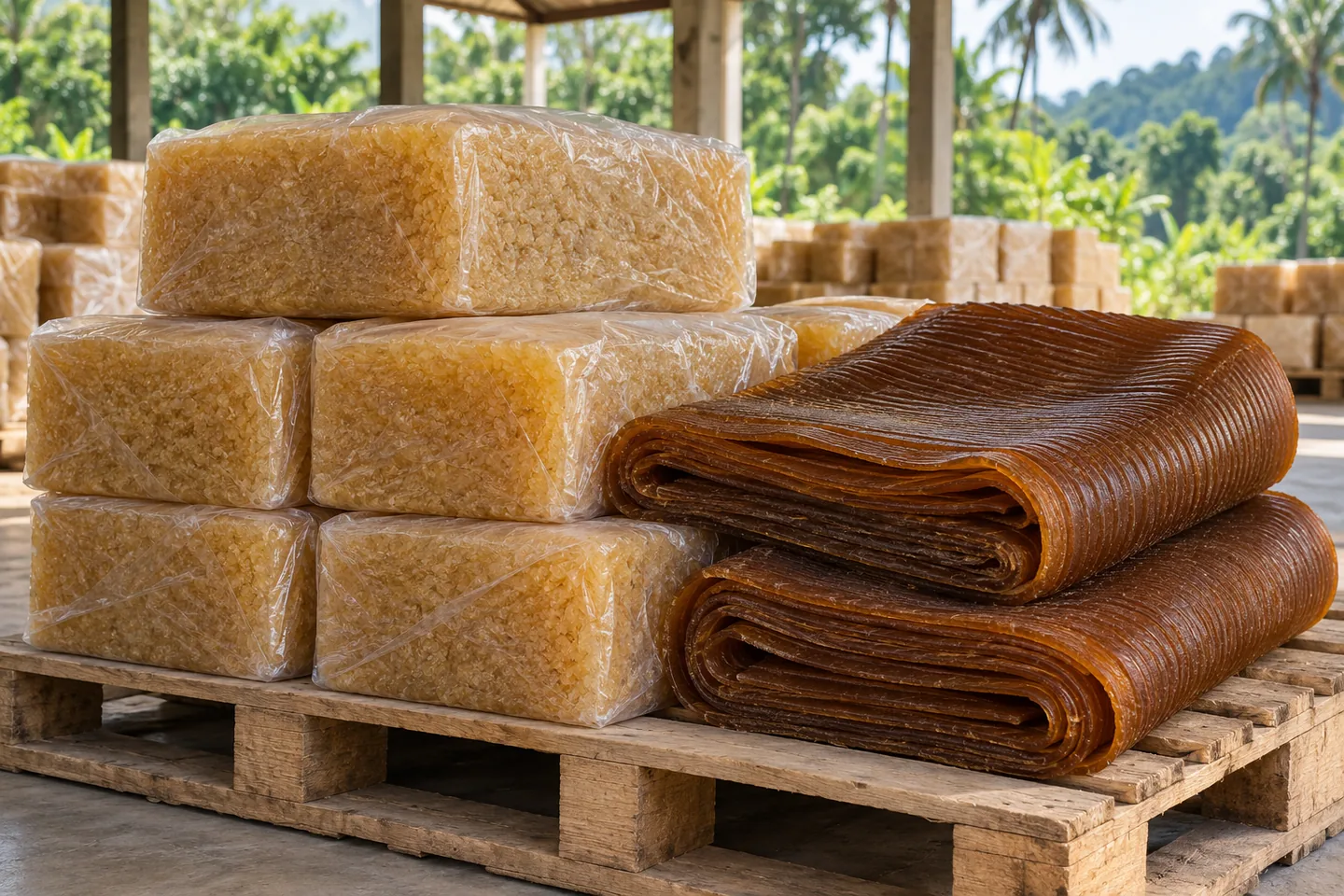
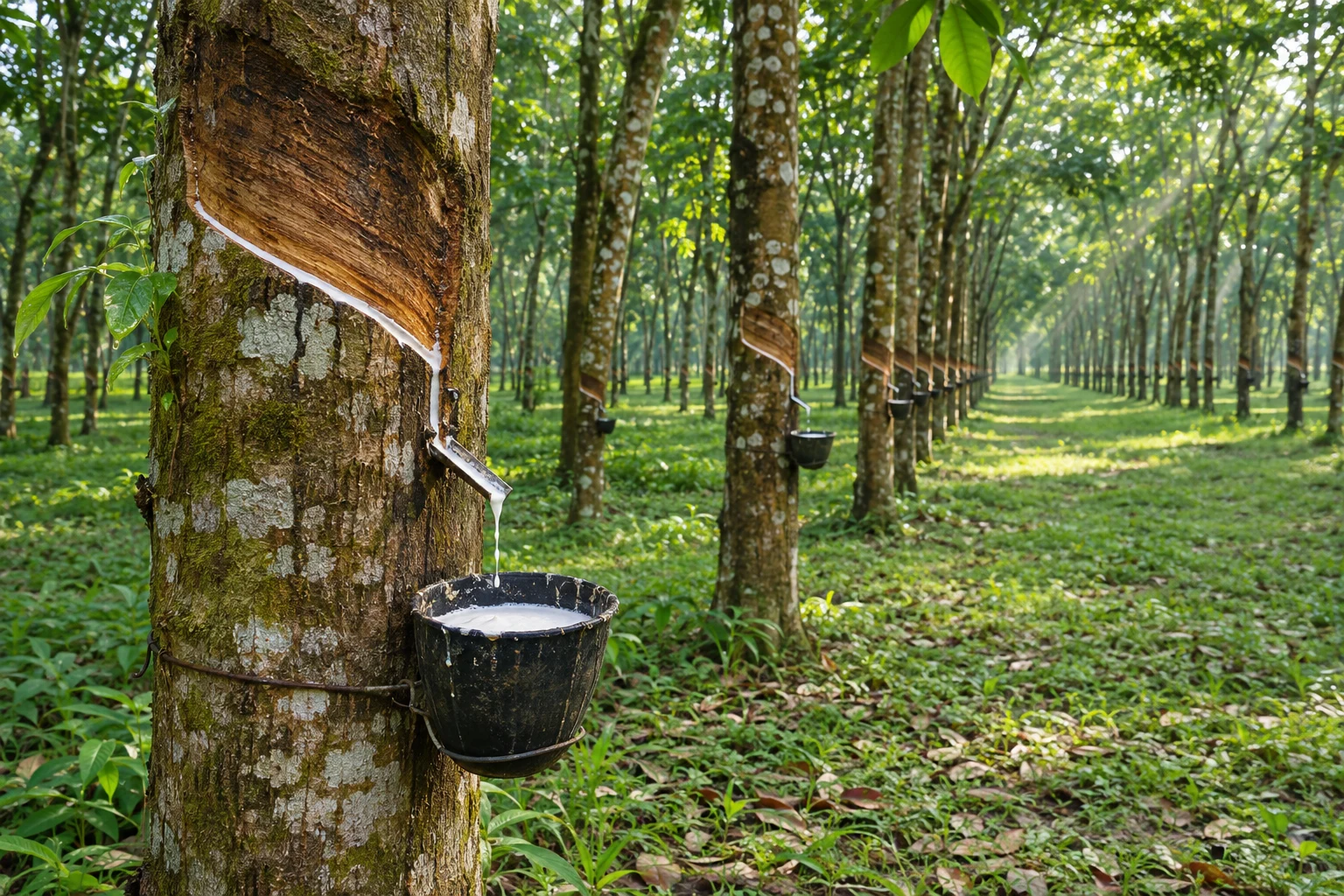
Natural rubber inputs and manufactured rubber products from the Malaysian and Indonesian supply base. We distinguish raw-material grades for compounders from finished components specified by drawing, polymer and service conditions.
Tyres and rubber compounding · Latex dipping and foam manufacture · Automotive and industrial components · Sealing, vibration isolation and construction products
Technically specified natural rubber
Standard Malaysian Rubber (SMR) and Standard Indonesian Rubber (SIR) are country-specific grading systems for technically specified rubber. Grades such as SMR 10/20 and SIR 10/20 are used in tyre and general rubber manufacturing. State the exact grade and origin required.
Constant-viscosity grades
CV and related controlled-viscosity grades are relevant where processing consistency matters. Grade designations and producer specifications must be checked individually; a similar label does not establish automatic interchangeability between origins.
Natural latex concentrate
Latex concentrate serves dipping, foam and other latex-processing applications. High-, medium- and low-ammonia options have different formulation implications. Enquiries should state dry rubber content, preservative system and processing requirements.
Ribbed smoked sheet and specialty rubber
Ribbed smoked sheet is a separate natural-rubber form. Specialty enquiries can include epoxidised or deproteinised natural rubber where a formulation calls for them. Selection and availability are reviewed against the required grade and application.
Moulded and extruded components
Seals, gaskets, bushes, profiles, mats and related industrial parts are specified by drawing and material performance. Natural rubber and synthetic elastomers are different choices; identify fluid exposure, temperature and mechanical requirements before selecting a compound.
Gloves and other dipped products
The regional manufacturing base also produces gloves and other dipped articles. Medical, industrial and food-handling applications have distinct requirements. Product-specific approvals and supporting documents must be confirmed for the intended market.
Technical overview
From latex to product
Natural latex
Collected raw material
Processing routes
Concentrating, coagulating or smoking
Material forms
Latex, TSR blocks or sheets
Manufactured goods
Compounding, shaping and curing
Schematic classification; route and treatment depend on the product.
Specification guide
Choose the material route
General purchasing guidance. Grade examples and reference standards are subject to technical review; availability and final acceptance criteria are agreed for each order.
Form
Typical application
Procurement focus
SMR / SIR technically specified rubber
Tyres and technical rubber compounding
Exact grade, dirt, ash, volatile matter, plasticity and viscosity requirements
Ribbed smoked sheet
Compounding and moulded goods
Agreed visual grade, contamination and bale condition
Latex concentrate
Dipping, foam and latex-based manufacture
Dry rubber content, preservative system, stability and cleanliness
Specialty / processed rubber
Process-specific compounds
Modification, viscosity or compound formulation and validation
Manufactured rubber products
Seals, gaskets, mouldings and industrial components
Drawing revision, polymer, hardness, tolerances and service environment
Procurement notes
Start with the compound or the component
A tyre compounder buying SIR 20 and a contractor buying a finished seal need different information. Identify which stage of manufacture you are buying so the enquiry reaches the appropriate supply route.
Raw rubber specification
For block rubber, specify the grade and limits for relevant properties such as dirt, ash, volatile matter, plasticity retention and viscosity. Agree the certificate of analysis and sample-approval process with the proposed source.
Finished-part definition
Provide a dimensioned drawing, tolerances, polymer or approved compound, hardness and required performance tests. Clarify whether tooling, first-article approval and repeat-production quantities are part of the enquiry.
Packing, inspection & documentation
For dry rubber, agree bale weight, wrapping, palletisation and batch marking. For latex, specify compatible bulk or container packing and storage requirements. Finished parts need protection suited to their shape and storage life, with traceability to the approved material and production batch.
Rubber and Rubber Products · Enquiries
A useful quotation starts here.
Send the details below. Supply scope, specification, origin and commercial terms are confirmed in the individual offer.